Sterlite Technologies Has Returned 746% Year to Date. Here Is What Changed and What the Market Is Pricing.
 आमच्यासोबत जोडा
 आम्हाला फॉलो करा
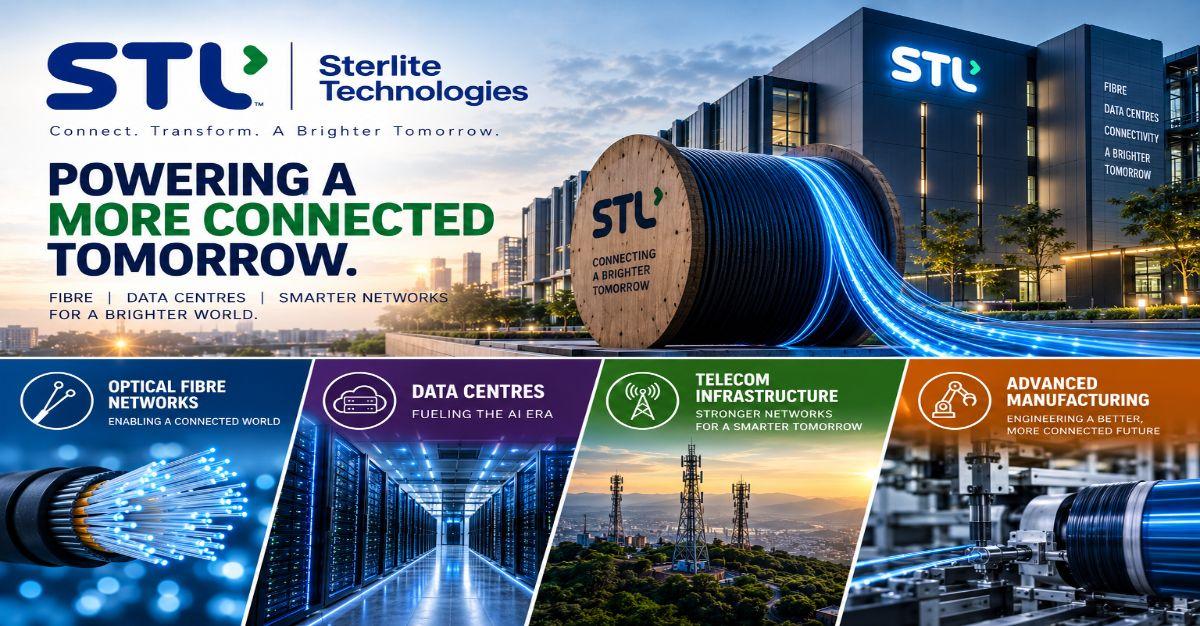
From Rs 84.65 to Rs 910. A record-breaking quarter, a USD 1.11 billion hyperscaler order, a net-debt-free balance sheet and a Rs 20,000 crore FY29 target. The story is real. The valuation requires equally honest examination.
✨ महत्त्वाचे मुद्दे
The 52-week low of Rs 84.65 was touched on January 27, 2026. The 52-week high of Rs 910 was reached on September 15, 2026. From that low, the stock has risen approximately 975 per cent in seven months — one of the sharpest recoveries recorded for a listed Indian industrial company. Year-to-date the return is 746 per cent. Over one year it is 602 per cent. multibagger returns by any definition.
Understanding this move requires understanding what STL looked like before it started.
Why the Stock Was at Rs 85
The three-year revenue CAGR of negative 11.8 per cent and three-year profit change of negative 42.9 per cent describe a business that went through a severe down cycle. Revenue peaked above Rs 6,000 crore in FY23 before declining sharply as the global telecom capex cycle weakened. Customers — primarily telecom operators in India, the US and Europe — deferred fibre rollout programmes. STL's capacity was built for a revenue run rate it was no longer generating. Operating leverage worked in reverse. The company reported losses in multiple consecutive quarters from December 2023 through March 2025.
The quarterly data shows the trough precisely. Revenue fell from Rs 1,522 crore in June 2023 to Rs 843 crore in March 2024 — a 45 per cent decline. PAT went deeply negative. The balance sheet accumulated debt. The stock fell to levels that priced the company as if the down cycle was permanent.
It was not permanent. It was cyclical.
The Structural Shift That Changed Everything
The catalyst for the recovery is a genuine structural change in the demand for optical fibre connectivity not just a telecom cycle recovery.
AI data centres operate fundamentally differently from traditional cloud data centres. In a traditional data centre, the network primarily connects servers to users. In an AI factory, tens of thousands of GPUs must communicate with each other continuously in real time. The network is not a support layer — it is an integral part of the compute system itself.
The fibre content consequence of this shift is striking. Managing Director Ankit Agarwal presented this progression at the September 3 Lakshya roadmap event, sourced from Nvidia's GTC presentation: a legacy front-end rack required approximately 1,000 fibres. Hopper-era racks require approximately 4,000 fibres. Blackwell racks require approximately 16,000 fibres. Vera Rubin — expected from the second half of 2027 — will require approximately 64,000 fibres per rack. That is a 64x increase in fibre content per rack across a few generations of AI infrastructure.
The second demand driver is data centre interconnect. As AI clusters scale across multiple buildings on a campus, the interconnections multiply exponentially. Two data centres require one interconnection. Four require six. Six require fifteen. Ten require forty-five. Every new data centre added to a campus multiplies the interconnection requirement, creating demand that grows faster than the number of facilities being built.
These two dynamics — more fibre per rack and more connections between racks are simultaneously expanding the optical total addressable market in a manner that has no precedent in the telecom fibre cycle. STL is India's largest end-to-end optical manufacturer, with approximately 9 per cent global optical cable market share outside China, producing everything from the glass preform through to connectivity solutions in-house. This vertical integration positions it directly in the path of the structural demand shift.
Q1 FY27: The Strongest Quarter in Company History
Q1 FY27 delivered performance that management described as the strongest quarter in STL's history — a statement that deserves specific numbers rather than repetition.
|
Metric |
Q1 FY26 |
Q4 FY26 |
Q1 FY27 |
YoY Change |
|
Revenue (Rs crore) |
1,019 |
1,441 |
1,910 |
87% |
|
EBITDA (Rs crore) |
140 |
218 |
397 |
184% |
|
EBITDA Margin |
13.70% |
15.10% |
20.80% |
+710 bps |
|
PAT (Rs crore) |
10 |
59 |
197 |
1870% |
|
PAT Margin |
1.00% |
4.10% |
10.30% |
+930 bps |
Revenue of Rs 1,910 crore grew 87 per cent year-on-year. EBITDA of Rs 397 crore grew 184 per cent year-on-year with a margin of 20.8 per cent — the highest in approximately 20 quarters. PAT of Rs 197 crore was 3.5 times the full-year FY26 PAT in a single quarter.
The geographic shift within that revenue is equally significant. North America contributed 54 per cent of Q1 FY27 revenue, up from 39 per cent in FY26. The data centre segment contributed 21 per cent of Q1 revenue, up from approximately 1 per cent in FY26. Management expects the combined data centre and enterprise segment to reach 50 per cent of revenues for the full fiscal year FY27 — well above the 30 per cent guidance provided in the previous earnings call.
The USD 1.11 Billion Order and the Record Order Book
The single most important development disclosed alongside Q1 results was a multi-year contract worth USD 1.11 billion — approximately Rs 10,000 crore — with a global hyperscaler for optical connectivity products for next-generation AI data centres, with delivery through FY29. Management also disclosed multiple USD 100 million-plus hyperscaler orders for the Neuralis portfolio — STL's purpose-built data centre connectivity solution — and a strategic long-haul dark fibre order.
In Q1 FY27 alone, STL secured orders worth Rs 13,100 crore — 1.7 times the total order wins of Rs 7,687 crore recorded across the entire FY26. The open order book stands at a record Rs 18,618 crore, up 2.4 times from the previous quarter. Of this, Rs 2,228 crore is scheduled for execution in Q2 FY27, with the remaining Rs 16,390 crore executable over Q3 FY27 and beyond. An order book of Rs 18,618 crore against FY26 full-year revenue of Rs 4,750 crore provides approximately 3.9 years of revenue coverage.
The Lakshya FY29 Plan: Scale and Ambition
On September 3, 2026, STL presented its FY29 growth roadmap — internally named Lakshya — to institutional investors. The targets are explicit: revenue of Rs 20,000 crore by FY29 and EBITDA margins of 27 per cent or above. From FY26 revenue of Rs 4,750 crore and EBITDA margins of 13.2 per cent, this represents more than 4x revenue growth and approximately 1,380 basis points of margin improvement over three years.
Four drivers underpin this ambition. The first is optical total addressable market expansion as fibre moves deeper into AI infrastructure. The second is customer co-development — STL is increasingly engaging earlier in the design cycle, moving from component supplier to connectivity architecture partner. The third is integrated connectivity solutions, where STL sells the full connectivity stack rather than individual cables. The fourth is technology-led differentiation through hollow-core fibre, multi-core fibre and co-packaged optics development, with 2 per cent of annual revenue committed to R&D.
To support this, STL will invest approximately Rs 1,000 crore annually over the next three fiscal years — Rs 3,000 crore in total — expanding preform, fibre and cable capacities by 50 per cent. A greenfield optical connectivity facility is being established in India, targeting employment for more than 3,000 women. A USD 100 million investment over five years in the United States will build connectivity manufacturing capacity close to hyperscaler customers.
The Balance Sheet Transformation
The other structural development that underpins the re-rating is the balance sheet repair. STL completed a Qualified Institutions Placement of Rs 1,500 crore in Q1 FY27. The book was subscribed more than 2.5 times, with participation from Nomura, HSBC, Motilal Oswal and Bank of India, among others. Institutional holdings reached a fresh historic high of 33 per cent. The company deployed 75 per cent of QIP proceeds toward debt reduction and became net debt-free — reporting a net cash position of Rs 483 crore. CRISIL revised its rating outlook to Stable. ICRA upgraded the credit rating to AA Stable.
The FII and DII accumulation pattern that coincided with this balance sheet improvement is visible in the shareholding data. FII holding increased from 11.47 per cent in March 2026 to 18.22 per cent in June 2026 to 19.71 per cent in July 2026 — an increase of 8.24 percentage points in four months. DII holding rose from 10.84 per cent in March 2026 to 13.27 per cent in July 2026. Together, institutional ownership increased by over 10 percentage points in four months, representing one of the more significant short-term accumulations recorded in a large Mid-Cap Indian industrial company.
Valuation: The Right Framework
Trailing P/E of 189x and ROE of 1.24 per cent are both artefacts of the loss-making quarters that immediately preceded the recovery. Using them to assess STL at the current moment misleads in both directions.
The more relevant metrics are EV/EBITDA, price to sales and ROCE trajectory. EV/EBITDA of 52.3x is elevated against the industry P/E of 55.2x — noting that the industry PE here reflects the broader sector, and EV/EBITDA is the more appropriate operating metric for a capital-intensive manufacturer. Price to sales of 7.91x on FY26 revenue of Rs 4,750 crore, against a market cap of Rs 44,630 crore, reflects the market pricing FY29 revenue rather than FY26 revenue. ROCE of 7.65 per cent trailing will need to improve substantially as the Lakshya revenue scales — at Rs 20,000 crore revenue and 27 per cent EBITDA margins, the implied EBITDA is approximately Rs 5,400 crore, against the current capital employed of approximately Rs 2,929 crore. That is a return profile that would justify the premium significantly.
CFO to EBITDA of 83.3 per cent confirms strong earnings quality — the operating profits being generated are converting to cash at a high rate. Free cash flow is positive at Rs 344 crore. Piotroski score of 8/9 signals improving financial health across multiple balance sheet and earnings quality indicators.
The Risks That Must Be Named
The Lakshya plan requires 4x revenue growth in three years from a base that itself recovered from a down cycle. The FY29 targets are stated alongside an explicit risks and assumptions page in the growth roadmap presentation management has flagged continued AI infrastructure momentum, supply chain resilience on critical raw materials including germanium and helium, favourable tariff and trade policy, and timely capacity ramp-up as assumptions underpinning the plan. Each of these carries execution and geopolitical uncertainty.
STL acknowledged in the Q1 call that it is already capacity-constrained and is selectively taking orders. The Rs 3,000 crore capex programme and 50 per cent capacity expansion are responses to that constraint but capacity being planned today will not all be operational before FY29. Germanium and helium availability remain work in progress, with management noting cost pressures in both areas and efforts underway to diversify sourcing and reduce consumption through technology substitution.
The stock at Rs 867 has priced in a substantial portion of the Lakshya ambition. The market is not valuing FY26 or even FY27 earnings — it is valuing the probability that FY29 delivers Rs 20,000 crore revenue at 27 per cent margins. That is a different investment decision from one being made on current fundamentals, and it carries the uncertainty appropriate to a three-year forward target in a business whose three-year historical trajectory ran in the opposite direction.
The Q1 FY27 results, the order book, the balance sheet and the institutional accumulation all confirm a business that has genuinely inflected. The distance between that inflection and the FY29 destination is the risk the current price is asking investors to carry.
Disclaimer: This article is for informational purposes only and not investment advice.