Lenskart Share Price Jumps 8%; Q2 FY27 Profit More Than Doubles, Store Expansion and Manufacturing Scale Boost Margins
 எங்களுடன் சேருங்கள்
 எங்களைப் பின்தொடரவும்

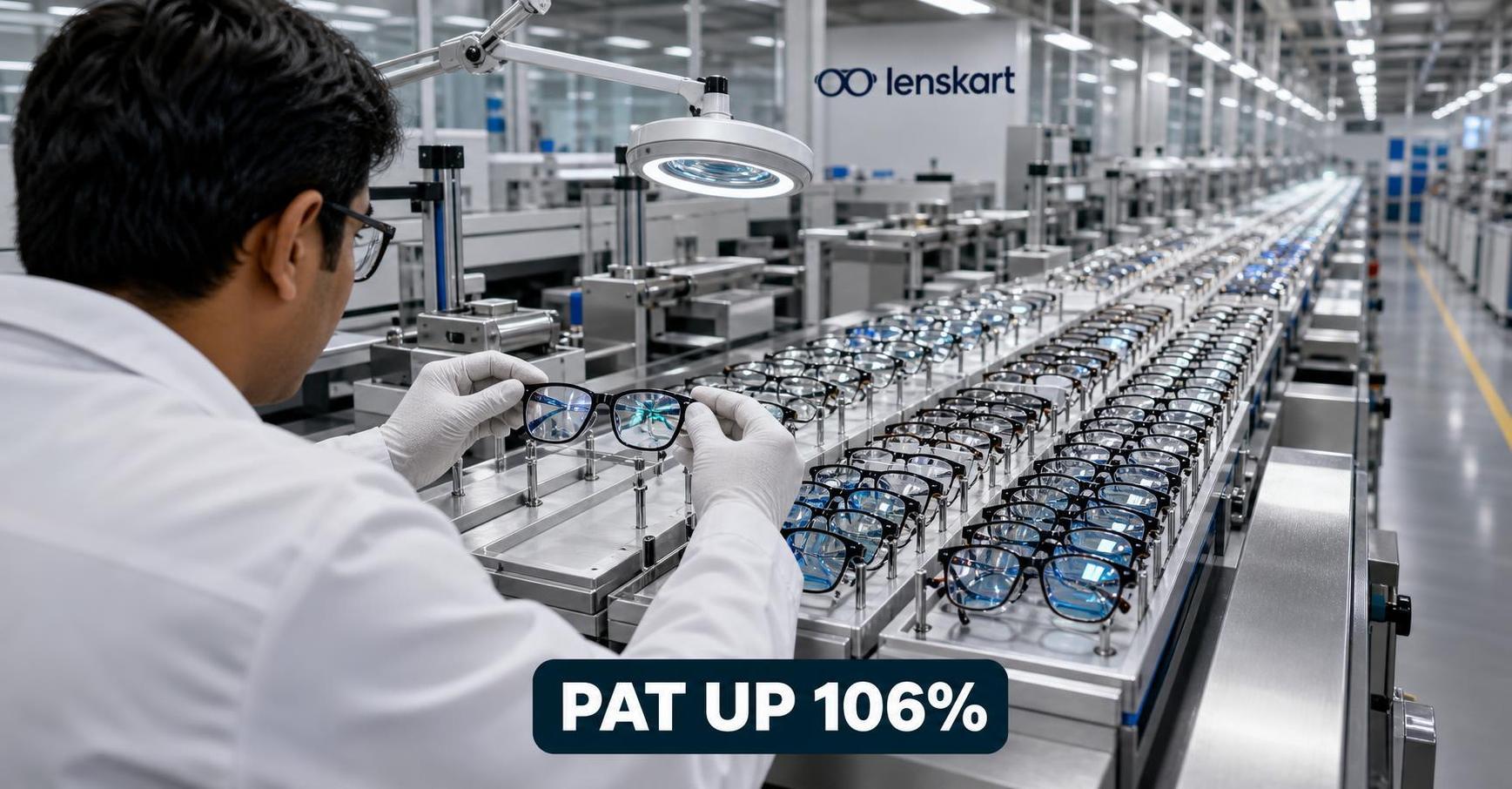
Lenskart reported strong Q2 FY27 pro forma growth, with revenue rising 32.5 per cent YoY and profit more than doubling as India and international operations expanded.
✨ முக்கிய குறிப்புகள்
Lenskart Solutions has been expanding its technology-led omnichannel eyewear network while increasing control over manufacturing and supply-chain operations. The company reported Q2 FY27 pro forma revenue of Rs 2,845 crore, up 32.5 per cent YoY, while profit after Tax (PAT) more than doubled to Rs 232 crore.
Earnings before interest, taxes, depreciation and amortisation (EBITDA) rose 46.6 per cent YoY to Rs 624 crore, outpacing revenue growth and lifting the EBITDA margin to 21.9 per cent. PAT margin stood at 8.2 per cent. For the first half of FY27, revenue increased 33 per cent to Rs 5,559 crore, EBITDA rose 53.4 per cent to Rs 1,213 crore and PAT grew 138 per cent to Rs 461 crore.
India remained the larger growth engine, with quarterly revenue climbing 35.3 per cent YoY to Rs 1,668 crore. India EBITDA rose 50.5 per cent to Rs 362 crore, while same-store sales growth was 20.8 per cent. The domestic network added 143 net new stores during the quarter, taking active stores to 2,868. International revenue grew 29.5 per cent to Rs 1,201 crore, with EBITDA increasing 45.9 per cent to Rs 264 crore.
Operating activity also strengthened. The group conducted 0.8 crore eye tests during the quarter, up 40.4 per cent YoY, and sold 1.1 crore eyewear units, up 27.1 per cent. In-house frame production across India, China and Thailand rose 71.7 per cent to 36 lakh units, while lens production increased 52.2 per cent to 20 lakh units. The company is also developing a centralised Hyderabad facility for lens edging and fitting.
Cash generation remained supportive of expansion. Lenskart reported Rs 388 crore of operating cash flow in H1 FY27 and Rs 297 crore of net cash flow before mergers and acquisitions. Its cash balance stood at Rs 3,855 crore, while return on capital employed improved to 22.5 per cent from 19 per cent a year earlier. The results indicate that higher store additions and manufacturing investment are being accompanied by improving operating leverage, although sustaining service quality and supply-chain readiness will remain important as the network expands.
As of 9:12 am on November 5, 2026, Lenskart shares were trading at Rs 745.05, up 7.82 per cent from the previous close of Rs 691.00. The company’s market capitalisation was Rs 1,20,218 crore. Institutional ownership has also increased, with foreign institutional investors holding 18.26 per cent, up 5.5 percentage points from the previous reported level, while domestic institutional ownership rose 3.24 percentage points to 26.8 per cent.
What This Means for Investors
The quarter supports Lenskart’s argument that store expansion, eye-test access and a broader product range can raise volumes without eroding profitability. India’s healthy same-store sales growth alongside 143 net new domestic stores is particularly significant because it suggests that network densification is still generating incremental demand. Higher in-house frame and lens output could further improve product availability, costs and margins over time.
The development is potentially supportive for the investment case because profit growth is outpacing revenue growth and operating cash flows are funding store and manufacturing investment. International profitability is also improving, although its expansion pace remains dependent on technology and supply-chain integration. The key uncertainty is execution. Rapid rollout into smaller markets requires consistent eye-testing capacity, Logistics, trained staff and customer experience. Valuation remains demanding, with the stock trading at a trailing price-to-earnings multiple of 154.08 times and enterprise value to trailing EBITDA of 49.02 times, leaving limited room for operational slippage.
Disclaimer: The article is for informational purposes only and not investment advice.