September 2026 Market Outlook: What Lies Ahead for Indian Equities
 Join Us
 Follow Us

August 2026 saw large-cap weakness amid global risks, while mid- and small-caps gained; Fed policy, crude oil, and FPI flows remain key September drivers.
✨ Key Takeaways
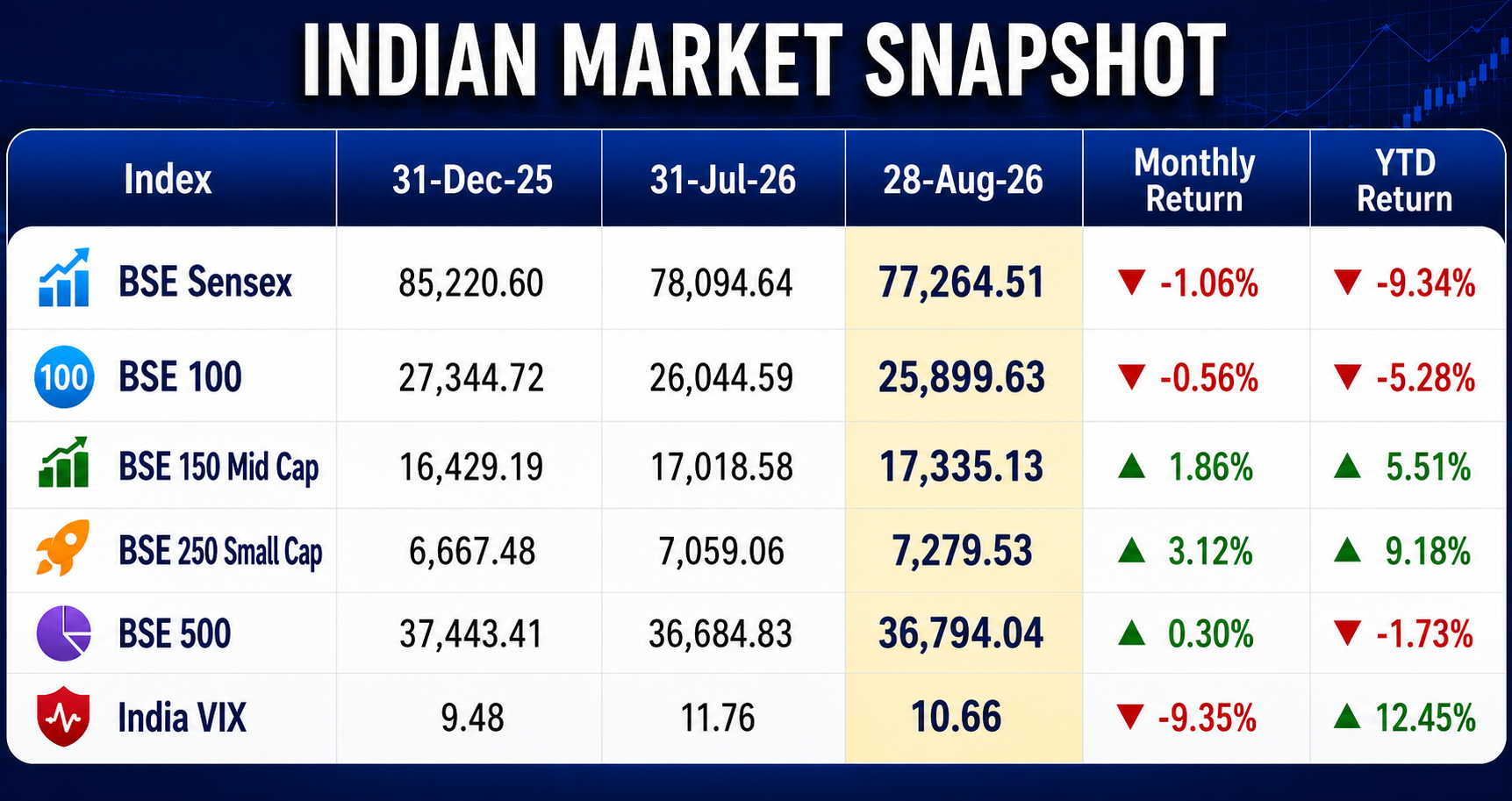
August 2026 ended India’s equity market’s two-month positive streak - but only at the Large-Cap level. The BSE Sensex slipped 1.06 per cent, while the BSE 100 fell 0.56 per cent month to date as of August 28, interrupted by a sharp late-month sell-off triggered by a combination of a hawkish Federal Reserve signal, rising crude oil prices, and renewed geopolitical escalation. The narrative, however, had a split ending. The BSE 150 Mid Cap gained 1.86 per cent, while the BSE 250 Small Cap surged 3.12 per cent, with both indices reaching fresh 52-week highs. India VIX fell another 9.35 per cent to close at 10.66 - now less than 25 per cent above its pre-crisis level and within touching distance of fully normalising. The market that matters to retail investors in India is, by most measures, in better shape than the headline indices suggest.
The month’s defining development was a sudden shift in global bond market expectations. Kevin Warsh, Chair of the US Federal Reserve, delivered a blunt message at Jackson Hole: “If inflation persists at rates higher than our long-term target, we have work to do.” Markets interpreted this as a signal that a September rate hike - not a cut - was back on the table. The probability of a rate hike jumped from 37 per cent to over 57 per cent within days. US Treasury yields rose, the dollar strengthened, and crude oil crossed USD 90 per barrel as geopolitical tensions added fuel. FIIs sold Rs 5,040 crore on the final Friday of August alone. The result was a month that had been quietly positive through August 27, only to end with a late jolt, leaving investors watching three key variables - bond yields, the dollar, and crude oil - as the September FOMC meeting on September 16 approaches.
Key Market Performance - August 2026 & YTD
Large caps bore the brunt of the late-month selloff, while mid and small caps sustained their uptrend and reached new 52-week highs. The India VIX at 10.66 is now 61 per cent below its March panic peak of 27.89 - one of the clearest signals that systemic fear has largely drained out of the market.
The Bond Market Is Now the Equity Investor's Most Important Signal
August’s late sell-off was not driven by weak domestic data. India’s Q1 FY2026–27 GDP data was broadly positive. Real GDP growth accelerated to 7.8 per cent from 6.9 per cent a year earlier, while nominal GDP growth rose to 10.3 per cent from 8.1 per cent.
Other major economic barometers are also broadly on track. Credit growth remains healthy, GST collections are firm, and the RBI held its repo rate steady at 5.25 per cent at its August 5 meeting, maintaining a neutral but supportive stance. The next MPC meeting is scheduled for October 7–9, and most analysts still expect the RBI to consider resuming its easing cycle if inflation remains contained. The disruption in August came from the other side of the world, and its transmission mechanism deserves careful examination.
Kevin Warsh, Jackson Hole, and the Rate-Hike Probability Shift
Fed Chair Kevin Warsh’s Jackson Hole remarks, specifically the phrase “we have work to do,” shifted the market’s base case from a September rate cut to a potential September hold or hike. The probability of a September rate hike rose from 37 per cent to over 57 per cent, crossing the psychological 50 per cent threshold that can trigger behavioural changes in global portfolio positioning. Higher-for-longer US rates mean higher US Treasury yields, a stronger dollar, and reduced relative attractiveness of emerging market assets. The immediate transmission into Indian markets was visible: the rupee weakened to Rs 95.56, FIIs sold aggressively on August 28, and equity markets fell.
Is This 2022 All Over Again?
Will the Fed repeat the rate hikes it implemented in 2022? The short answer is: not yet, and probably not. In 2022, inflation was extreme and persistent. The Fed raised rates repeatedly and rapidly, credit markets showed serious stress, technology stocks collapsed across the board, and market breadth deteriorated at every level. Today’s picture is different across most of those dimensions.
US high-yield credit markets are not showing signs of panic. Technology and AI-related stocks have maintained relative strength even through August’s volatility. Market breadth, while softer, has not shown the broad-based deterioration that preceded the 2022 bear market. What August has delivered is a repricing of rate expectations and a dollar-strength episode, not a systemic credit or inflation crisis. Whether it becomes one depends on whether US inflation re-accelerates, how the September FOMC meeting resolves, and, critically, whether crude oil sustains levels above USD 90.
The Dollar, Indian G-Sec Yields, and FPI Flows
A stronger dollar creates two distinct pressures for India. For markets, it reduces the dollar-denominated returns of foreign investors holding Indian equities, making allocation to India less attractive relative to US assets. For the real economy, it raises the cost of dollar-denominated imports, external borrowings, and input costs for companies with significant dollar liabilities.
Indian G-Sec yields have edged higher in sympathy with US Treasury yields, narrowing the India-US yield differential and further complicating the case for foreign fixed-income allocation to India. The rupee, at Rs 95.12 per dollar, remains a key variable. Further depreciation would amplify both the risk of imported inflation and the drag on FPI returns. The October RBI MPC meeting and the Fed’s September 16 decision will together determine whether this yield and currency pressure stabilises or intensifies.
Crude at USD 90+: Three Geopolitical Threads Converging
Brent crude crossed USD 91 per barrel in late August, a level that materially changes the risk calculus for India. At USD 70–75, India’s current account and inflation outlook are manageable, and the RBI has room to ease. At USD 90+, the equation reverses: imported inflation rises, the current account deficit widens, the rupee faces pressure, and corporate margins across aviation, paints, FMCG, chemicals, and Logistics come under simultaneous pressure.
Three separate geopolitical developments are converging to push oil prices higher. First, US forces struck two Iranian launchers in late August, marking the first known American strikes on Iranian assets since July and sharply escalating the Iran-US confrontation. Critically, Iran has now formally stated that no agreement with the Trump administration is possible before his term ends in 2029. This is not a conflict with a near-term diplomatic resolution. It is a multi-year structural risk to Middle East oil supply, and Indian markets will need to price it accordingly.
Second, the Russia-Ukraine conflict has escalated, with attacks on Russian refining infrastructure. Reports indicate that 30–40 per cent of Russian refinery capacity has been affected, reducing Russia’s ability to produce refined petroleum products domestically. As a result, Russia, one of the world’s largest crude producers, is now importing refined fuels, with India emerging as one of its suppliers. This represents a structural change in global refined-product flows, with potential margin implications for Indian refiners.
Third, the UAE’s exit from OPEC+ in May continues to create uncertainty around coordinated supply management, with the cartel’s ability to respond to price volatility now structurally weakened. Together, these three developments create a supply environment that is tighter and more uncertain than at any point since the original Iran-Israel escalation in early 2026.
FII and DII Flows - August 2026
For the first time in thirteen months, FIIs were technically net buyers of Indian equities, with net buying of Rs 454 crore through August 28, the last session for which data is available. Through August 27, FII net buying had reached approximately Rs 5,494 crore, marking a genuine improvement in foreign sentiment, driven by stabilising crude oil prices, a moderating rupee, and improving Q1 FY27 earnings. Then came Friday, August 28, when FIIs sold Rs 5,040 crore in a single session, erasing nearly the entire month’s accumulation and narrowing the net figure to near zero. With one trading session still remaining on August 31, for which data is not yet available, the final monthly figure could well slip into negative territory, given the scale of the August 28 sell-off and the headwinds from rising crude oil prices, a hawkish Fed signal, and a weaker rupee. What had been building as a meaningful trend reversal may end as a rounding error.
DIIs purchased Rs 53,679 crore during the month, maintaining their consistent and structural presence. The 13-month cumulative picture from July 2025 through July 2026 tells the real story: FIIs have net sold Rs 5.36 lakh crore of Indian equities, while DIIs have purchased Rs 9.36 lakh crore over the same period, absorbing foreign outflows nearly two times over. Indian markets have not merely survived this extraordinary selling; they have demonstrated remarkable resilience in the face of it.
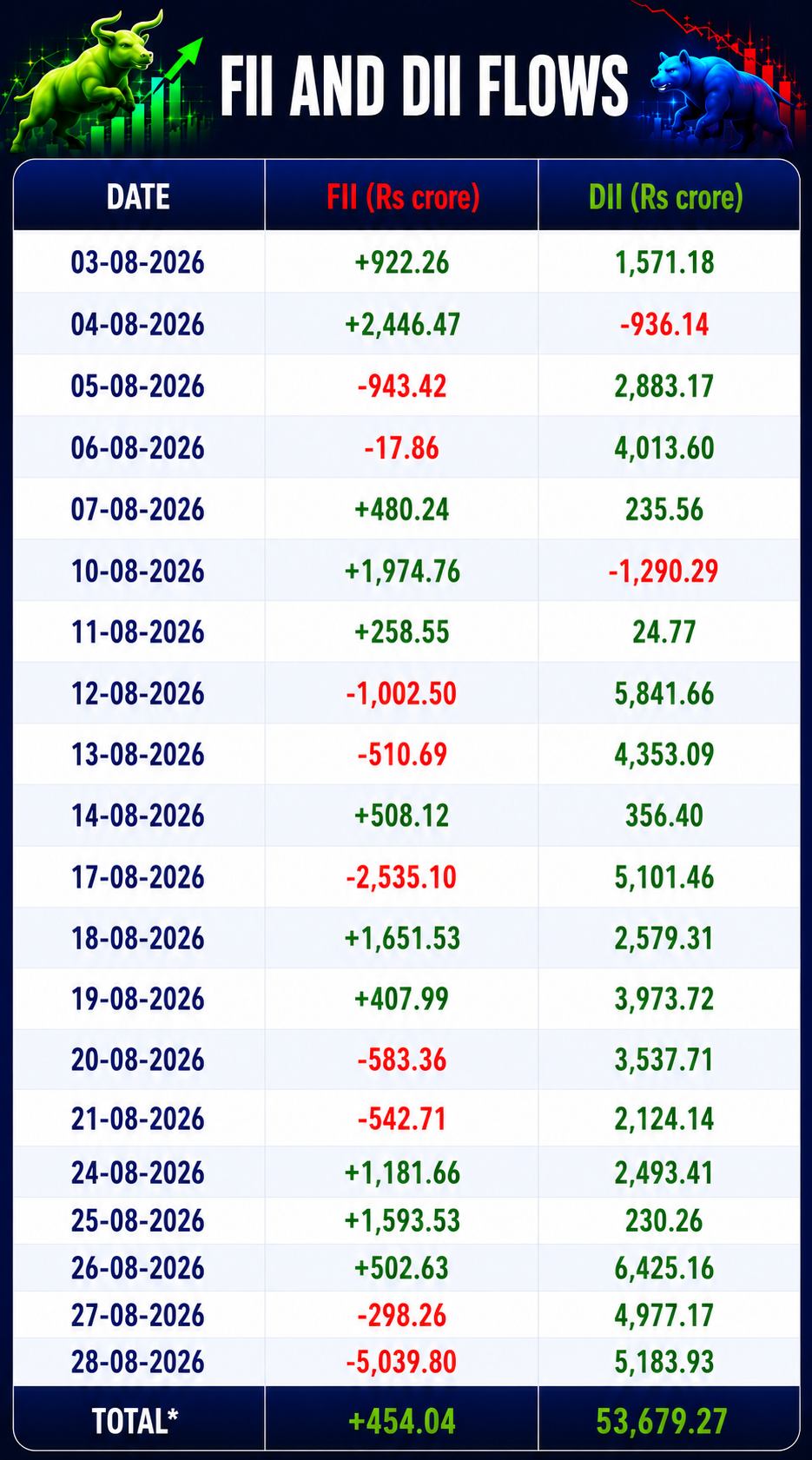
- FII flow data is available only through August 28. August 31 data will be reflected in next month's update.
Sectoral Movements - August 2026
Nifty Metal +6.34 per cent: A Supply Story, Not a Demand Boom
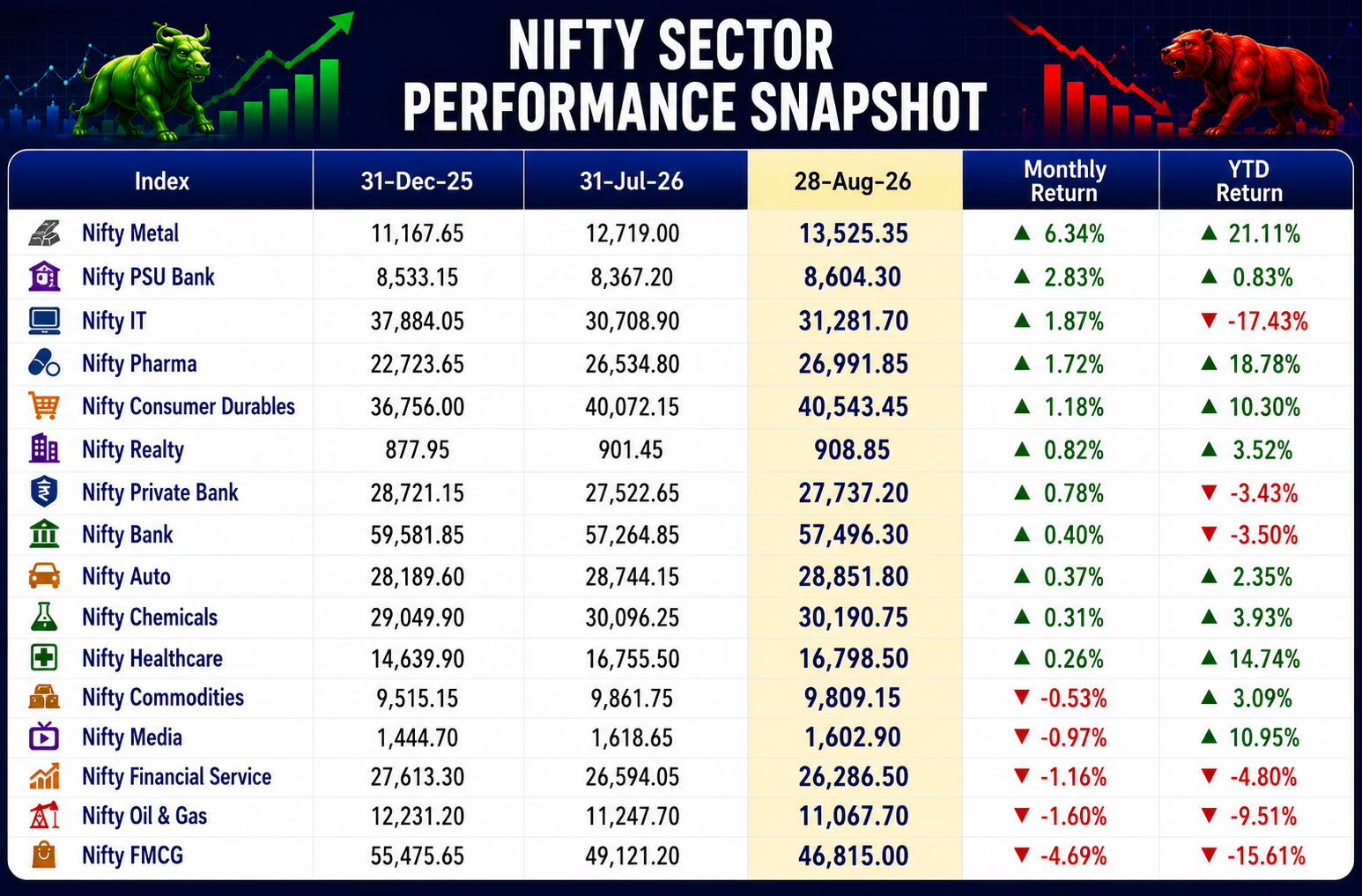
Nifty Metal’s 6.34 per cent monthly gain, taking its YTD return to +21.11 per cent, the strongest among all major sectors, was driven by three converging factors: global copper prices approaching record highs as mine disruptions and SMElter outages tightened supply; a 12 per cent recovery in domestic long-steel prices following the June-July correction; and China’s monthly steel production falling by approximately 7 per cent YoY to 86.6 million tonnes, reducing the export pressure that had weighed on Indian steel margins. The structural demand narrative, with copper, aluminium, and steel all benefiting from EV manufacturing, power grid expansion, renewable energy, and data centre buildout, has given the rally durability beyond the near-term commodity cycle. Analysts specifically characterise August’s metal move as supply-driven rather than a demand boom, which is an important distinction. Supply-driven rallies can persist even without a broad acceleration in global growth.
Nifty FMCG -4.69 per cent in August, -15.61 per cent YTD: A Valuation and Margin Story
FMCG’s continued underperformance is not a result of a consumption collapse. Rural demand has been recovering, and volume growth has remained positive. The sector’s 2026 de-rating is primarily a valuation and margin compression story. Rising input costs, including palm oil, packaging materials, and energy-linked raw materials, have squeezed margins faster than price increases can compensate, creating a difficult earnings dynamic. FMCG stocks entered 2026 carrying significant valuation premiums as defensive plays. As bond yields rose and other sectors offered better risk-reward, that premium evaporated. Foreign investors have reportedly sold approximately USD 5.2 billion of FMCG stocks over the past twelve months, with elevated valuations and margin pressure cited as the primary reasons. A recovery requires input cost normalisation and evidence that volume growth can accelerate beyond price-led revenue gains.
Nifty 50 Technical Outlook
The Nifty 50 closed near 24,080 after a volatile August, briefly touching 24,700 before losing momentum. The 200-day EMA, near 24,600–24,700, continues to act as the key overhead hurdle. The index’s failure to close decisively above this level for any sustained period keeps the longer-term trend cautious. The RSI (14) has slipped to around 44, below its signal average, indicating weakening momentum and a shift towards bearish-neutral territory.
For September, 24,000 is the crucial support zone. Sustaining levels above it would keep the consolidation intact and allow another attempt at 24,400–24,700. A decisive breakout above 24,700 would open the path towards 25,000–25,300. A break below 24,000 would increase selling pressure towards 23,700–23,500, with 23,300 as the next significant support.
The September 16 FOMC decision is the single most important near-term catalyst. A hold with a dovish tone could unlock a breakout above 24,700, while a hike or a persistently hawkish signal would likely put 24,000 and lower levels to the test. The technical bias is neutral to cautiously positive above 24,000, but confirmation requires a decisive close above 24,700 on meaningful volume.
Company Performance - August 2026
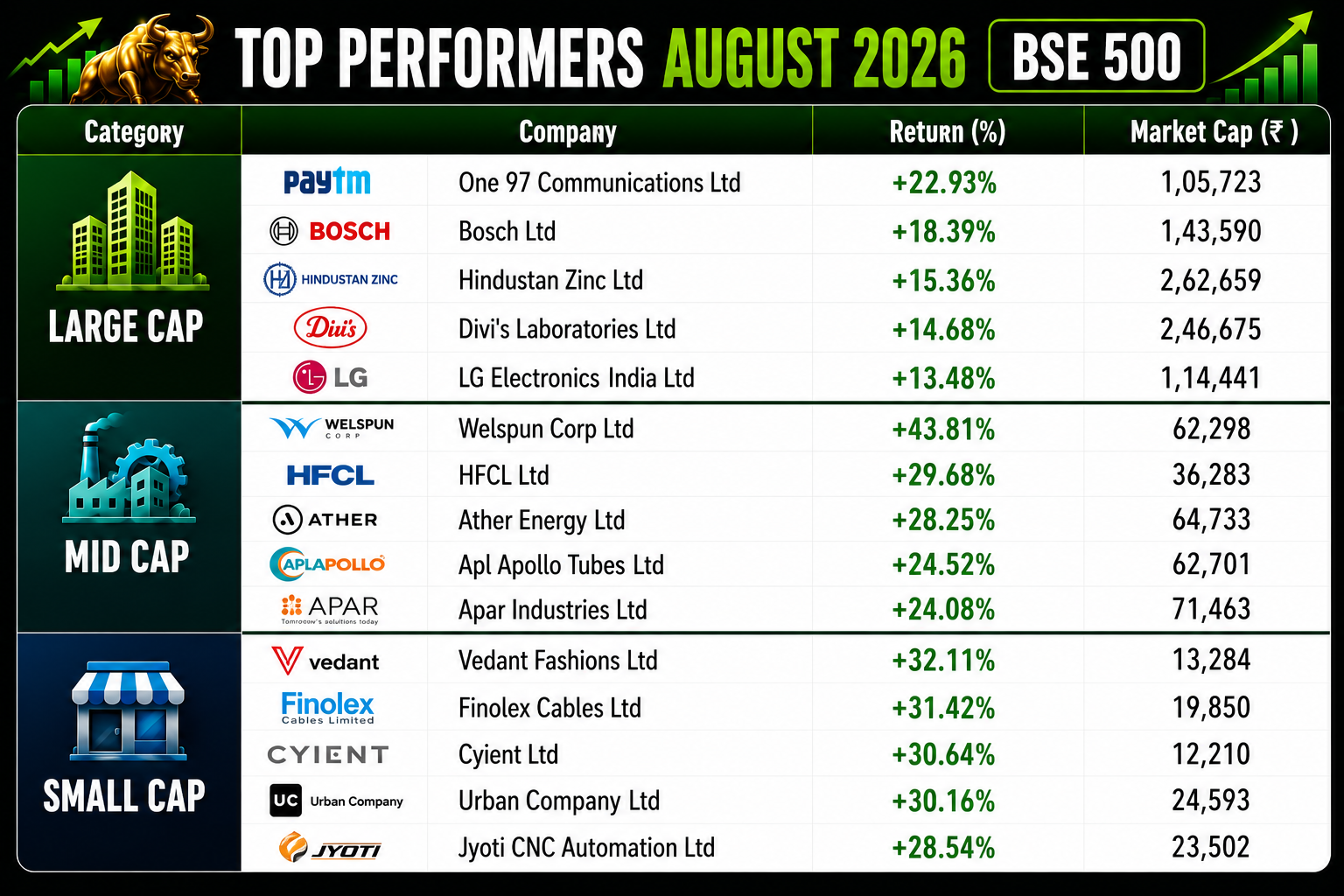
- Return data is calculated as per closing of August 28.
Conclusion
August 2026 delivered a clear message: Indian equity markets are in good structural health, but they are not immune to the global bond market. The broader market, including mid caps, small caps, and the BSE 500, continues to build on its recovery, driven by domestic fundamentals that remain sound. However, the large-cap indices remain sensitive to a set of global variables that August brought sharply back into focus: US bond yields, the dollar, and crude oil.
The September FOMC meeting on September 16 is the most important single event for Indian equity investors in the near term. If the Fed holds rates and signals a clear easing path, it would remove the primary headwind behind late August’s sharp sell-off. If it hikes rates or maintains an aggressively hawkish posture, yields could rise further, the dollar could strengthen, and crude oil could remain elevated, putting the Nifty’s 24,000 support level to a genuine test.
Three variables, Fed policy, crude oil above or below USD 90, and the direction of FPI flows, will determine whether August’s late jolt was a temporary interruption to India’s recovery or the beginning of a more complex second half of 2026. For long-term investors, the underlying story remains intact. In the near term, however, September will demand close attention.
Disclaimer: The article is for informational purposes only and not investment advice.