Evaluating Corporate Performance Through Ratio Analysis
 Join Us
 Follow Us
The Investor’s Guide to Decoding Financial Health and Efficiency
✨ Key Takeaways
Financial statements like the Balance Sheet and Profit & Loss account are often filled with intimidating rows of numbers. For a retail investor, looking at a company that made Rs 1,000 crore in profit might seem impressive. However, numbers in isolation rarely tell the full story. To truly understand how a company is performing, we need to look at the relationship between these numbers. This is where Ratio Analysis comes into play.
Think of ratio analysis as a medical health check-up for a company. Just as a doctor looks at your blood pressure relative to your age and weight, an analyst uses ratios to see if a company’s financial "vitals" are healthy.
Why Do We Use Ratios?
If Company A makes Rs 100 crore in profit and Company B makes Rs 10 crore, you might think Company A is better. But what if Company A used Rs 5,000 crore of capital to make that profit, while Company B only used Rs 20 crore? Suddenly, Company B looks like a much more efficient machine. Ratios allow us to:
1) Compare Apples to Apples: You can compare a massive corporation with a local Mid-Cap company by looking at percentages rather than total currency figures.
2) Identify Trends: By looking at ratios over several years, you can see if a company is getting more efficient or falling into a debt trap.
3) Spot Red Flags: Ratios can highlight problems in liquidity or declining margins long before a company starts losing money.
The Four Pillars of Ratio Analysis:
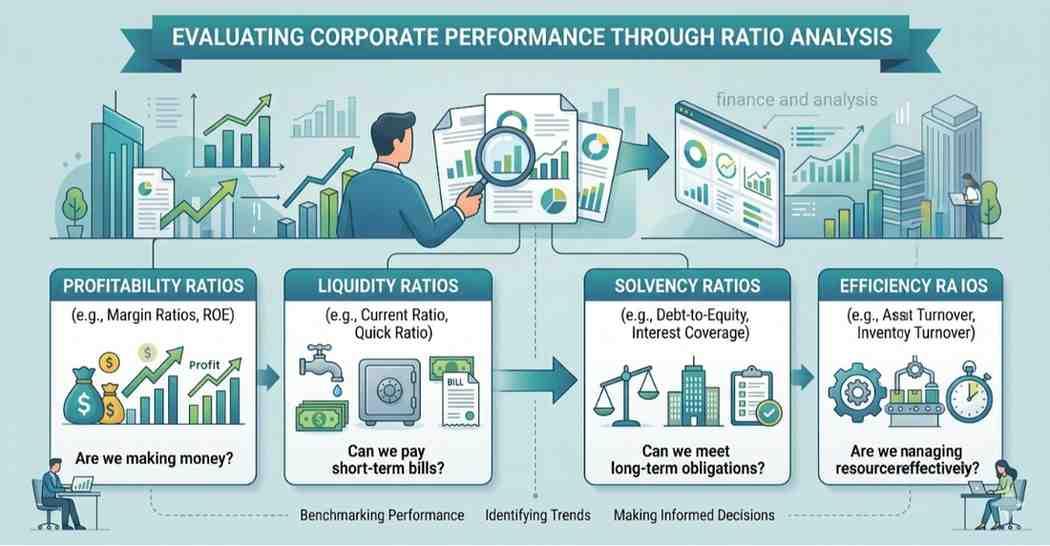
Most financial ratios fall into four main categories:
1) Profitability Ratios: These tell you how efficient a company is at turning sales into profit. The Return on Equity (ROE) is a favourite for shareholders as it measures the profit generated for every Rs 1 of their investment.
2) Liquidity Ratios: A company can be profitable but still go Bankrupt if it lacks cash. The Current Ratio checks if a company has enough short-term assets to pay its immediate bills.
3) Solvency Ratios: These look at the long-term debt load. The Debt-to-Equity Ratio shows if a company is relying too heavily on borrowed money, which can be risky during an economic downturn.
4) Efficiency Ratios: These measure how well a company manages its resources, such as how quickly it sells its inventory.
A Simple Comparison: Two Coffee Shops
Imagine two competing coffee shops: Brew-Master and Daily-Grind.
Brew-Master earns Rs 1,00,000 in profit from Rs 10,00,000 in sales. While this looks good, its Net Profit Margin is 10 per cent. More importantly, the owner has borrowed Rs 8,00,000 to run the shop, making it very "debt heavy." If interest rates rise, this shop could struggle to survive.
In contrast, Daily-Grind earns a smaller profit of Rs 75,000, but it only needed Rs 5,00,000 in sales to get there. This gives it a much higher Net Profit Margin of 15 per cent. Furthermore, Daily-Grind has almost no debt, meaning its profit is "safer." Even though Brew-Master makes more total money, Daily-Grind is the more efficient and financially stable business.
Conclusion
Ratio analysis is the bridge between raw data and actionable intelligence. It tells you not just what happened, but how and why it happened.
However, ratios should never be used in a vacuum. A high debt ratio might be normal for a power plant but a disaster for a software firm. Always compare a company's ratios against its past performance and its industry peers. By mastering these simple metrics, you move beyond "guessing" and start making investment decisions based on financial reality.
Disclaimer: The article is for informational purposes only and not investment advice.