The Invisible Pipeline: How the Clearing and Settlement Cycle Works
 Join Us
 Follow Us
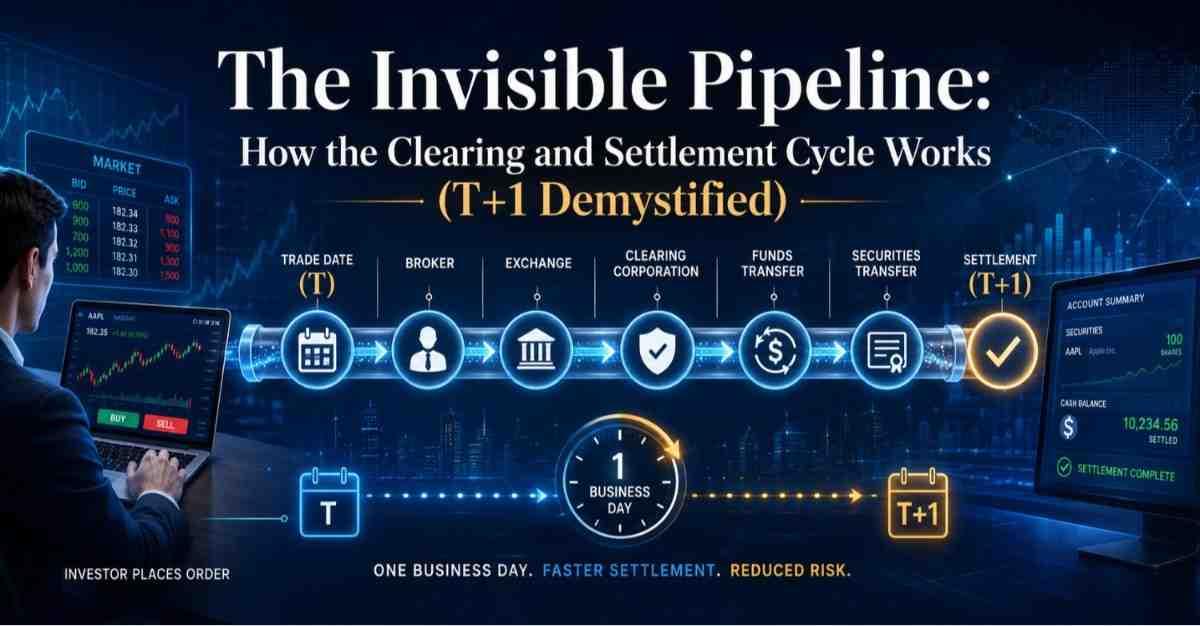
A simple guide to trade execution, netting, and delivery in the Indian stock market.
✨ Key Takeaways
When you open a trading app like Zerodha, Groww, or Angel One, tap a button to buy a stock, and see a confirmation message flash across your screen, it feels instantaneous. You pressed "Buy," your app says you own it, and your available balance updates.
However, what happens on your screen is just the digital handshake. Behind the scenes, a massive, highly regulated financial engine roars to life. The actual transfer of money from your account to the seller, and the transfer of legal stock ownership from the seller to you, doesn’t happen in milliseconds. In the Indian stock market, this process operates on a swift T+1 timeline.
In fact, India was one of the first major economies in the world to fully mandate a T+1 settlement cycle for equities, making our stock market infrastructure incredibly advanced. Here is a look at what happens behind the scenes during the lifecycle of a trade, breaking down how the clearing and settlement cycle works.
The Golden Words: Execution, Clearing, and Settlement
To understand the journey, we must first separate a single trade into three distinct phases:
- Trade Execution (T+0): This is the exact second you click "Buy" or "Sell" and your order is matched with a counterparty on an exchange like the National Stock Exchange (NSE) or Bombay Stock Exchange (BSE). You have agreed on a price, but no assets or funds have actually changed hands yet.
- Trade Clearing: The middle phase where specialized financial institutions calculate exactly who owes what, verify that the buyer has the funds, ensure the seller actually has the shares in their Demat account, and prepare the paperwork.
- Trade Settlement (T+1): The final step where the actual exchange takes place. Money is officially moved, and the legal ownership of the stock is updated in the central electronic registry.
What does T+1 mean? The "T" stands for the Transaction Date (the day you made the trade). The "+1" means one business day later. If you buy shares on Tuesday morning, the trade officially settles on Wednesday. If you buy shares on Friday, it settles on Monday (weekends and trading holidays don't count).
Meet the Hidden Players
Before we walk through the 24-hour timeline, let’s introduce the critical entities that ensure the Indian market operates seamlessly:
- The Stock Broker: Your retail gateway to the market (like Zerodha, Groww, HDFC Securities).
- The Clearing Corporation (CC): Affiliated with the exchanges, these include NSE Clearing Limited (NCL) and Indian Clearing Corporation Limited (ICCL) for the BSE. The CC acts as the ultimate, impartial referee. They guarantee that if one party defaults mid-trade, the transaction will still be completed.
- The Depositories: This is where your shares actually live digitally. In India, we have two central depositories: NSDL (National Securities Depository Limited) and CDSL (Central Depository Services Limited).
Step-by-Step: The 24-Hour Journey of a Trade
Let’s look at exactly what happens to your trade over a standard T+1 cycle in India.
Phase 1: The Match (T+0 – Market Hours)
Imagine you buy 10 shares of Reliance Industries Limited (RELIANCE) or Infosys (INFY) at 10:00 AM on a Tuesday. Your broker sends this order to the NSE, where it instantly matches with a seller. At this moment, a binding contract is formed.
Phase 2: Netting and Risk Management (T+0 – Post-Market)
Once the Indian stock market closes at 3:30 PM, the clearing corporation (like NCL) steps in to perform a process called "multilateral netting." Instead of moving money and shares for every single individual trade, which would total crores of transactions a day, the clearing corporation pools everything together. It looks at all the buys and sells from every broker and distills them into a single net number.
The Netting Example: Suppose Broker A (e.g., Zerodha) has clients who bought Rs. 10 Crore worth of Tata Motors stock today, but other clients who sold Rs. 8 Crore of Tata Motors stock. Instead of processing Rs. 18 Crore in total movements, the clearing corporation nets the trades. At the end of the day, Broker A simply owes the clearing corporation Rs. 2 Crore.
This process reduces the actual amount of money moving through the Indian Banking system by over 90%, drastically lowering costs and systemic risk.
Phase 3: The Guarantee (T+0 – Overnight)
During the night, the clearing corporation legally steps into the middle of the trade. It becomes the buyer to every seller and the seller to every buyer, which is a financial process called novation. If a major selling broker suddenly faces an operational failure overnight, NCL steps in with its own massive Settlement Guarantee Fund to ensure you still receive your shares.
Phase 4: Final Settlement (T+1 – The Next Day)
By the next morning, the legal change of hands occurs through a well-timed "Pay-in" and "Pay-out" process.
Pay-in (Morning): The selling brokers deliver the shares from their clients' Demat accounts to the Clearing Corporation, and the buying brokers transfer the funds.
Pay-out (Afternoon): The Clearing Corporation distributes the funds to the sellers and transfers the digital share certificates into the buyers' CDSL or NSDL Demat accounts.
By Wednesday afternoon, the cycle is complete. You are now the official, legal owner of those shares, and the seller can fully withdraw their funds.
What Happens if the Seller Doesn't Have the Shares?
In rare cases, a seller might execute a sell order but fail to deliver the shares on T+1, which is often called a Short Delivery. Because the clearing corporation guarantees the trade, they won't let the buyer suffer.
Instead, the exchange holds an Auction on T+2. The clearing corporation buys the missing shares from the open auction market to deliver them to the original buyer. The defaulting seller is then hit with a hefty penalty, covering the auction costs and protecting market integrity.
Summary for Investors
The T+1 clearing and settlement cycle is the unsung hero of the Indian financial ecosystem. It balances the need for rapid liquidity with absolute security. By shrinking the timeline down to a single business day, SEBI (Securities and Exchange Board of India) has ensured that retail investors can re-use their capital much faster, reducing risk and establishing India as a global benchmark in financial technology.
The next time you tap "Buy" on your phone, you'll know that while your app dashboard updates instantly, a sophisticated network of clearing corporations and depositories is working diligently behind the curtain to deliver your assets safely by tomorrow.