Common ITR Filing Mistakes Every Taxpayer Should Avoid
 हमसे जुड़ें
 हमें फ़ॉलो करें
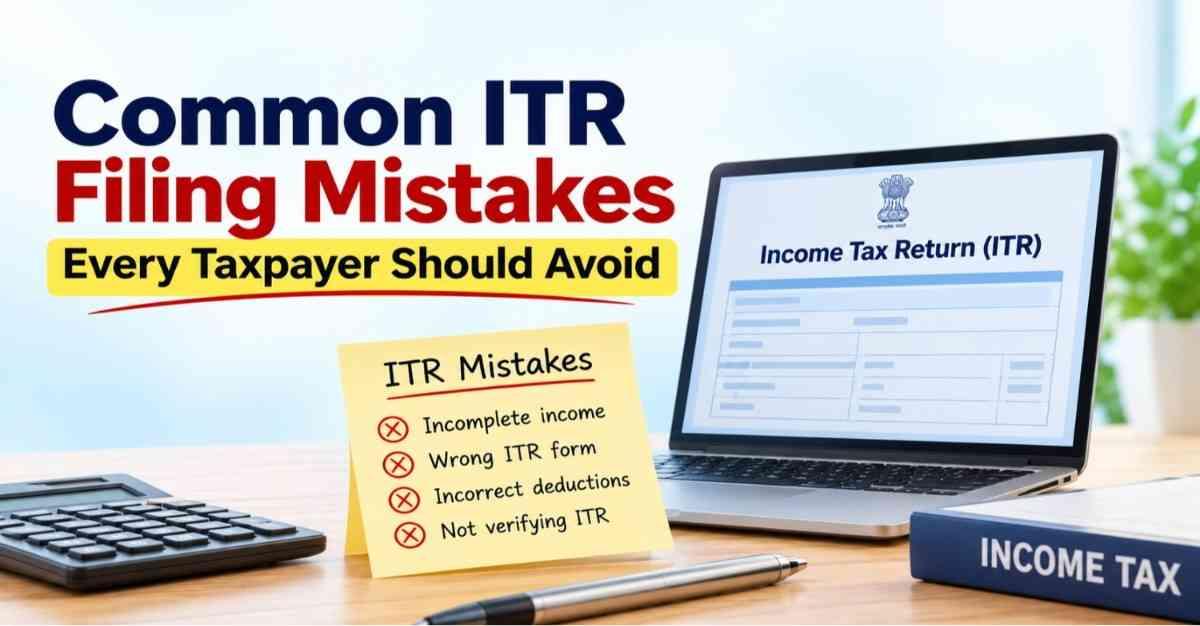
Filing an Income Tax Return accurately is essential for meeting tax obligations, claiming eligible refunds and avoiding unnecessary notices or penalties. However, taxpayers often make avoidable errors while selecting the ITR form, reporting income, claiming deductions or verifying the return. Even a minor discrepancy can delay processing or create complications with the Income Tax Department. Understanding the most common ITR filing mistakes can help taxpayers submit complete, accurate and timely returns.
✨ मुख्य निष्कर्ष
Filing an Income Tax Return is an important compliance responsibility for eligible taxpayers in India. An accurate and timely return helps taxpayers comply with tax laws, claim eligible refunds and avoid unnecessary notices, interest or penalties.
However, even a small mistake while reporting income, selecting the return form or entering personal information can delay processing or make the return defective. Taxpayers should therefore review their financial records carefully and avoid the following common mistakes while filing their ITR.
Not Reporting Every Source of Income
One of the most common filing mistakes is failing to disclose income received from all sources. Apart from salary or business income, taxpayers may earn interest from savings accounts, fixed deposits, recurring deposits, bonds, rental properties, Dividends or other investments.
Taxpayers should review their Bank statements, interest certificates, Form 16, Form 16A and other financial records before filing. The Annual Information Statement, or AIS, can also help identify reported transactions. However, the AIS may not contain every transaction, so taxpayers remain responsible for reporting complete and accurate information.
Selecting the Wrong ITR Form
Different ITR forms are prescribed for different categories of taxpayers and income sources. Selecting the wrong form may result in the return being treated as defective, requiring the taxpayer to correct and resubmit it.
For AssesSMEnt Year 2026–27, ITR-1 is generally available to eligible resident individuals with total income of up to ₹50 lakh from specified sources. ITR-2 applies to individuals and Hindu Undivided Families without business or professional income who are not eligible for ITR-1. ITR-3 generally applies where income from a business or profession is involved, while ITR-4 is an optional simplified form for eligible taxpayers declaring business or professional income under the presumptive taxation scheme. Eligibility conditions must be checked carefully before selecting a form.
Filing the Return After the Due Date
Delaying ITR filing can result in late filing fees, interest on unpaid taxes and the loss of certain tax benefits. It may also restrict the taxpayer’s ability to carry forward some categories of losses to future years.
Taxpayers should not wait until the final day to begin collecting documents. Filing early provides enough time to identify discrepancies, arrange tax payments and correct errors before submitting the return.
Entering Incorrect Personal Information
Errors in the taxpayer’s name, Permanent Account Number, date of birth, address, contact details or bank account information can delay return processing and refunds.
The information entered in the return should match the details available in the PAN and Aadhaar records. Taxpayers should also ensure that the bank account selected for receiving a refund is active and pre-validated on the income tax portal.
Failing to Verify the ITR
Submitting the return does not complete the filing process. The ITR must also be verified within the prescribed period.
Taxpayers can verify their return electronically through methods such as Aadhaar OTP, net banking, a pre-validated bank account or an Electronic Verification Code. Alternatively, a signed ITR-V may be sent to the Centralised Processing Centre.
The current time limit for completing e-verification or submitting ITR-V is 30 days from the date of filing. A return that is not verified may be treated as invalid.
Not Reporting Income From a Previous Employer
Taxpayers who change jobs during a financial year must report salary received from every employer. Reporting only the income earned from the latest employer can result in under-reporting of salary and incorrect calculation of deductions or tax liability.
Form 16 from each employer should be collected and reconciled with Form 26AS and the AIS before filing the return.
Ignoring Form 26AS and AIS
Form 26AS contains information relating primarily to tax deducted or collected at source against the taxpayer’s PAN. The AIS provides a broader view of reported financial information, including interest, dividends, securities transactions, tax payments and certain high-value transactions.
Taxpayers should compare these statements with Form 16, Form 16A, bank statements and their own records. Any discrepancy should be resolved with the employer, bank, deductor or reporting institution before the return is filed.
Not Disclosing Foreign Assets or Income
Taxpayers who are required to disclose foreign assets or income must provide complete details of overseas bank accounts, financial interests, properties, investments and income earned outside India.
Failure to disclose reportable foreign assets or income can have serious consequences under Indian tax laws. Since the disclosure requirements depend on residential status and the nature of the asset or income, professional advice may be necessary in complex cases.
Claiming Incorrect Deductions or Exemptions
Tax deductions should be claimed only when the taxpayer satisfies the applicable conditions and possesses the required supporting documents.
Claims under provisions such as Sections 80C, 80D, 80G and other eligible sections should be supported by investment statements, insurance receipts, donation certificates, tuition fee receipts or other relevant evidence. Taxpayers should also remember that the availability of deductions may differ depending on the tax regime selected.
Incorrect or excessive claims can lead to adjustments, additional tax liability or scrutiny by the Income Tax Department.
Not Paying Advance Tax or Self-Assessment Tax
Tax deducted at source may not always cover the taxpayer’s entire liability, particularly where income is earned from interest, rent, capital gains, a business or a profession.
Taxpayers should estimate their total liability and pay advance tax wherever applicable. Any remaining amount should be paid as self-assessment tax before filing the return. Delayed or insufficient payment may attract interest under the applicable provisions.
Using Incorrect or Unsupported Documents
Taxpayers should not submit false invoices, fabricated receipts or inaccurate documents to support deductions, exemptions or business expenses.
Every claim made in the return should be supported by genuine and verifiable records. Although supporting documents are generally not attached to the ITR, they should be preserved in case the Income Tax Department requests them during assessment or verification.
Assuming That Filing Is Unnecessary Below the Exemption Limit
A person may be required to file an ITR even when total income is below the basic exemption limit. Filing may become mandatory in specified circumstances, including where prescribed thresholds relating to current-account deposits, savings-account deposits, foreign travel expenditure, electricity expenditure, business turnover, professional receipts or aggregate TDS and TCS are crossed.
The Income Tax Department currently lists conditions such as deposits exceeding ₹1 crore in current accounts, foreign travel expenditure exceeding ₹2 lakh, electricity expenditure exceeding ₹1 lakh and aggregate TDS or TCS of ₹25,000 or more, with a higher threshold for senior citizens. Taxpayers should verify the conditions applicable to the relevant assessment year.
Not Maintaining Evidence for Deductions
Taxpayers must retain proper documentation for deductions claimed under Chapter VI-A and other provisions. These records may include insurance premium receipts, investment certificates, medical insurance documents, donation receipts, home-loan statements and tuition fee receipts.
A deduction may be disallowed during scrutiny if the taxpayer cannot provide satisfactory evidence supporting the claim.
Not Pre-Validating the Bank Account
An incorrect, closed or unvalidated bank account can delay the credit of an income tax refund.
Taxpayers should verify the account number, IFSC code and account status before filing. The preferred account should also be pre-validated and nominated for receiving refunds through the income tax portal.
Failing to Report Exempt Income
Income that is exempt from tax may still need to be disclosed in the appropriate schedule of the return. Depending on the circumstances, this may include qualifying agricultural income, specified exempt interest or other income covered by an exemption provision.
Reporting exempt income provides a complete picture of the taxpayer’s financial position and helps reduce the possibility of mismatches with information available to the tax authorities.
Not Reporting Capital Gains From Mutual Fund Switches
Switching from one mutual fund scheme to another is generally treated as a redemption of units in the original scheme and a fresh investment in the new scheme.
Any resulting capital gain or loss must therefore be calculated and reported, even when the money is transferred directly between schemes and does not appear as a credit in the taxpayer’s bank account. The capital gains statement provided by the mutual fund or registrar should be reviewed before filing.
Conclusion
Accurate and timely ITR filing requires more than simply entering figures from Form 16. Taxpayers should review all income sources, select the appropriate return form, reconcile Form 26AS and AIS, claim only eligible deductions and verify the return within the prescribed time.
Maintaining organised records and checking every entry before submission can help prevent defective returns, delayed refunds, additional tax liabilities and unnecessary notices. Taxpayers dealing with business income, capital gains, foreign assets or complex transactions should consider obtaining advice from a qualified tax professional.