Rekha Jhunjhunwala-Backed Motor Stock Falls 5% as Q1 FY27 Profit Remains Under Pressure; Check Details
 Join Us
 Follow Us
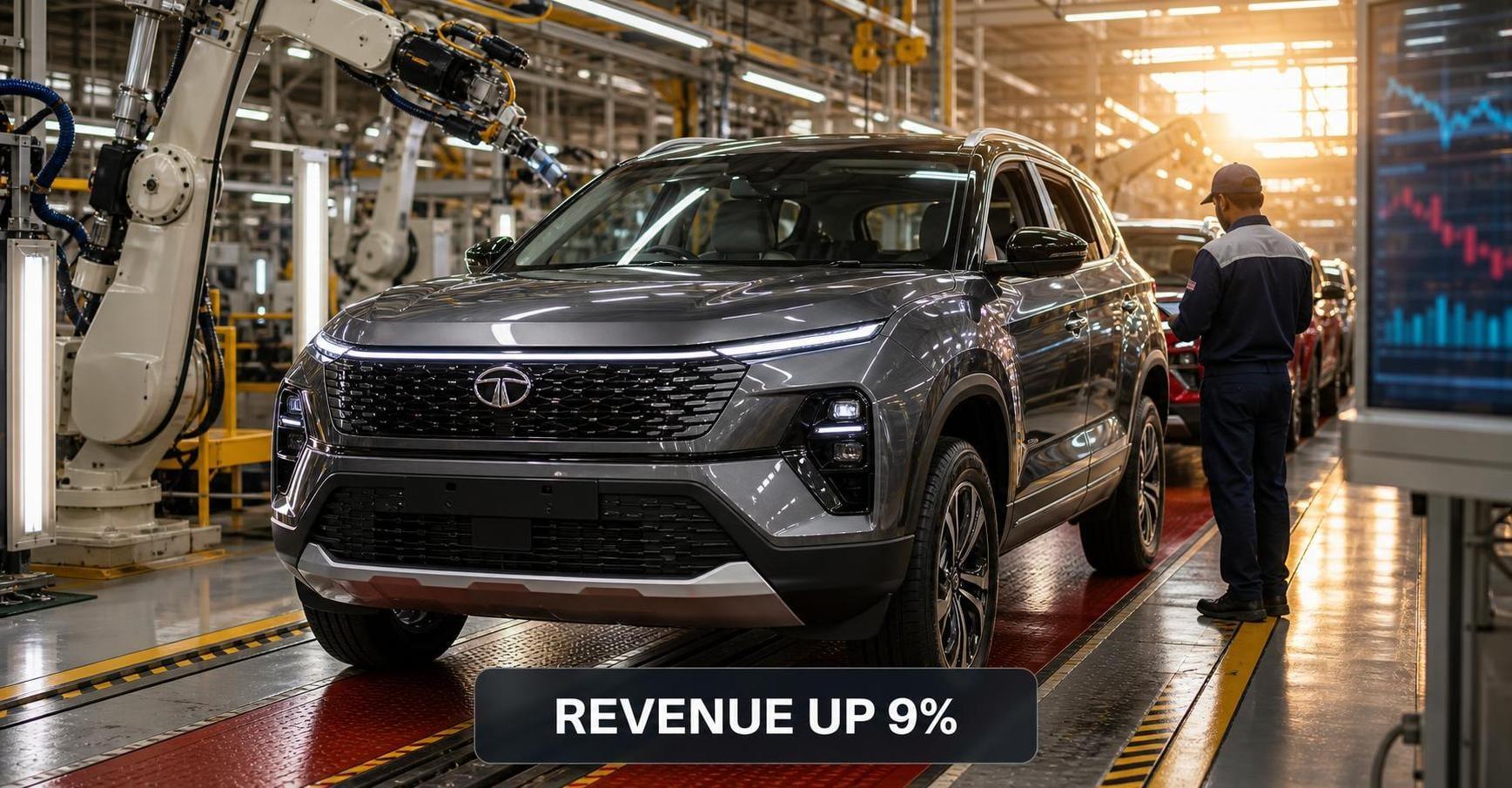
Tata Motors Passenger Vehicles reported Q1 FY27 consolidated revenue of Rs 95,799 crore, up 9.3 per cent YoY, while JLR performance was impacted by supply constraints, Middle East conflict and the planned wind-down of outgoing Jaguar models
✨ Key Takeaways
On Friday, Indian equity benchmark indices traded lower, with the benchmark Nifty 50 index falling 54.70 points, or 0.22 per cent, to 24,341.15. The Nifty Auto index also declined 215.80 points, or 0.73 per cent, to 29,176.35. Amid the market movement, Tata Motors Passenger Vehicles share price declined 5.06 per cent to Rs 331.90. The stock remained in focus after the company announced its Q1 FY27 financial results for the quarter ended June 30, 2026,
Notably, Rekha Jhunjhunwala holds a 1.33 per cent stake in Tata Motors Passenger Vehicles, according to the latest shareholding data
Tata Motors PV Consolidated Q1 FY27 Performance
Tata Motors Passenger Vehicles reported consolidated revenue of Rs 95,799 crore in Q1 FY27, up 9.3 per cent YoY from the corresponding quarter. Consolidated EBITDA stood at Rs 7,100 crore, with the EBITDA margin declining 130 basis points YoY to 7.4 per cent. EBIT margin stood at 2.4 per cent, down 90 basis points YoY. Consolidated PBT before exceptional items and tax declined to Rs 1,606 crore from Rs 3,950 crore in Q1 FY26, marking a 59.3 per cent YoY decline. Consolidated PAT at Rs 859 crore, compared with Rs 4,003 crore in Q1 FY26, representing a 78.5 per cent YoY decline.
Searching for the Next Multibagger Opportunity?
Explore DSIJ’s Multibagger Pick - a research-driven service focused on identifying fundamentally strong companies with the potential to generate exceptional long-term returns.
Download Service BrochureThe company said the performance was impacted by temporary supply-chain constraints, including a fire at a major component supplier, the Middle East conflict and the planned wind-down of outgoing Jaguar models, while elevated commodity and foreign exchange costs also moderated margin improvement. The domestic passenger vehicle business, however, delivered strong growth, with revenue increasing 64.8 per cent YoY to Rs 17,930 crore from the corresponding period, while EBITDA margin improved 30 basis points to 4.3 per cent.
Tata Passenger Vehicles Business Delivers Strong Growth
The Tata Passenger Vehicles business reported revenue of Rs 17,930 crore in Q1 FY27, registering growth of 64.8 per cent YoY. EBITDA margin improved 30 basis points YoY to 4.3 per cent, while EBIT margin improved by 230 basis points to negative 0.5 per cent. PBT before exceptional items and tax reached Rs 11 crore, compared with a loss of Rs 123 crore in Q1 FY26.
Volumes in the domestic passenger vehicle business grew 46 per cent YoY, significantly outperforming the industry. EV volumes increased 112 per cent YoY, with the company reporting quarterly EV volumes of more than 34,000 units. Tata Passenger Vehicles retained a Vahan market share of 14.3 per cent, while its EV Vahan market share stood at 39 per cent. EV penetration was 19 per cent and CNG penetration stood at 27 per cent during the quarter.
During the quarter, the company launched the next-generation Tiago and Tiago.ev, along with the all-new Sierra.ev. The company said the new avatars of Tiago and Punch received a strong response, while supply constraints affected Sierra volumes despite positive customer interest.
JLR Revenue Declines 9.6 per cent YoY
Jaguar Land Rover reported revenue of £5.97 billion in Q1 FY27, declining 9.6 per cent YoY. JLR wholesale volumes declined 9.2 per cent during the quarter due to temporary supply constraints, including a fire at a major component supplier, market disruption linked to the conflict in the Middle East and the planned wind-down of outgoing Jaguar models ahead of the launch of Jaguar Type 01.
JLR's EBITDA margin stood at 8.1 per cent, down 120 basis points YoY, while adjusted EBIT margin declined to 2.8 per cent from 4.0 per cent. PBT before exceptional items and tax stood at GBP 109 million, down 68.9 per cent YoY, while PAT declined to GBP 66 million from GBP 248 million in Q1 FY26. Retail VME increased to 7.1 per cent from 4.1 per cent, also affecting profitability. However, the mix of Range Rover, Range Rover Sport and Defender improved to 80.8 per cent from 77.2 per cent in the year-ago quarter.
Also Read - Penny Stock Under Rs 2 Announces Q1 FY27 Results: Revenue Rises 104%, Net Profit Turns Positive
New Product Launches and JLR Strategy
JLR is preparing to expand its battery electric vehicle portfolio, with four new products expected in the coming months, including Range Rover Electric, Range Rover Sport Electric, Range Rover GT and Jaguar Type 01. The company has also announced a five-year target for double-digit revenue growth through greater propulsion flexibility and a strategic refocus on North America.
JLR has also announced operating efficiency initiatives under its Enterprise Missions, with anticipated savings of GBP 1.7 billion over two years. In addition, JLR and Stellantis signed a memorandum of understanding to explore opportunities to collaborate on new products for the Defender brand specifically designed for the US market. Production of the first CJLR Freelander began on July 30 at the joint venture plant in Changshu, China.
Five-Year Strategy for Tata Passenger Vehicles
At its June investor day, Tata Passenger Vehicles announced a five-year strategy aimed at nearly doubling volumes, achieving a 20 per cent market share, delivering double-digit EBITDA margins and generating strong free cash flow. The company said the strategy will be supported by its product pipeline, sustained demand and focused margin improvement initiatives.
Demerger and Accounting Impact
The filing also highlighted the Composite Scheme of Arrangement involving the demerger of the commercial vehicle business along with related investments and the amalgamation of Tata Motors Passenger Vehicles Limited with the company to consolidate the passenger vehicle business. The scheme was approved by the National Company Law Tribunal, with an appointed date of July 1, 2025, and became effective on October 1, 2025.
Following the effectiveness of the scheme, the company recognised a gain of approximately Rs 82,616 crore in the consolidated income statement relating to the fair value of the Commercial Vehicle Undertaking. The filing specifically states that this gain had no impact on net worth.
EPR Requirement Under Review
The filing also highlighted the Extended Producer Responsibility requirements for end-of-life vehicles. Under the framework, OEMs are required to purchase certificates from registered vehicle scrapping facilities equivalent to 8 per cent of the relevant steel usage for the first five years, increasing to 18 per cent by 2039. The company stated that the cost of meeting the obligation could not be reliably estimated as of June 30, 2026, as the Central Pollution Control Board was still providing clarity on certificate costs, calculation methodology and transaction processes.
Add DSIJ as your preferred news source on G o o g l e
Add NowShare your thoughts in the comments below.
Disclaimer: The article is for informational purposes only and not investment advice.